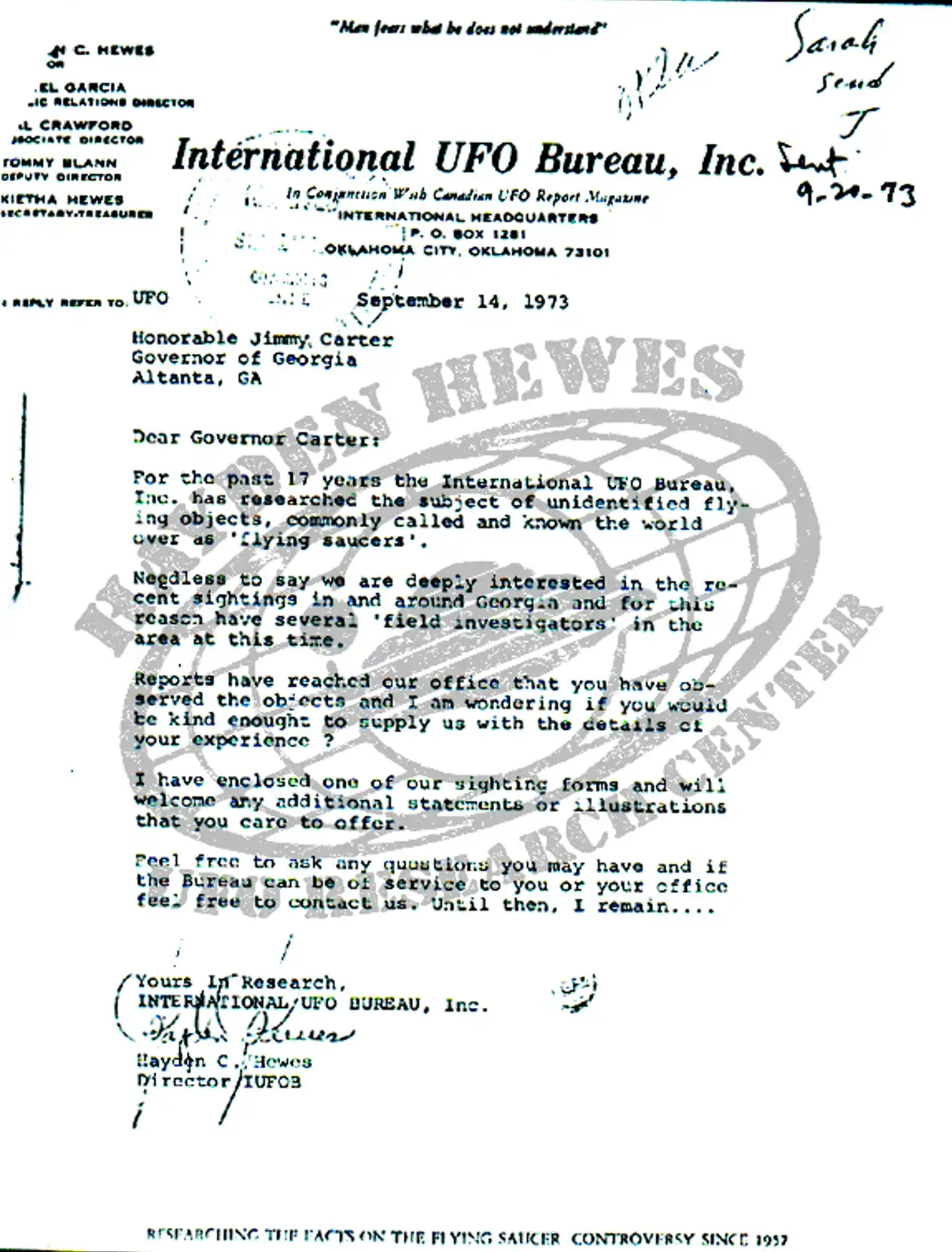
In September 1973, Hayden C. Hewes and the International UFO Bureau wrote Georgia Governor Jimmy Carter and asked him to describe a UFO sighting that had reached the Bureau through recent reports.
Carter did more than acknowledge the request. He completed IUFOB's sighting questionnaire by hand, signed it, and returned it to the organization.
That report became the center of a small but unusual collection of Carter material in the Hayden C. Hewes Archive: the original IUFOB letter, Carter's handwritten report, Hewes's later articles, newspaper coverage, and eventually a second investigation that argued the object could be identified.
The documents do not tell one simple story. They preserve both Carter's account and the later effort to explain it.
Hewes Writes the Governor
On September 14, 1973, IUFOB sent Carter a formal letter at the Georgia State Capitol. Hewes wrote that the Bureau had received reports that Carter had observed an unidentified object and asked him to provide the details of the experience.
Hewes enclosed one of IUFOB's standard sighting forms and invited Carter to add statements or illustrations if he wished.
Four days later, Carter dated and signed the completed report.
The Carter material in the Hewes Archive therefore begins with a direct exchange between IUFOB and Carter's office, not with a later newspaper retelling.
What Carter Reported
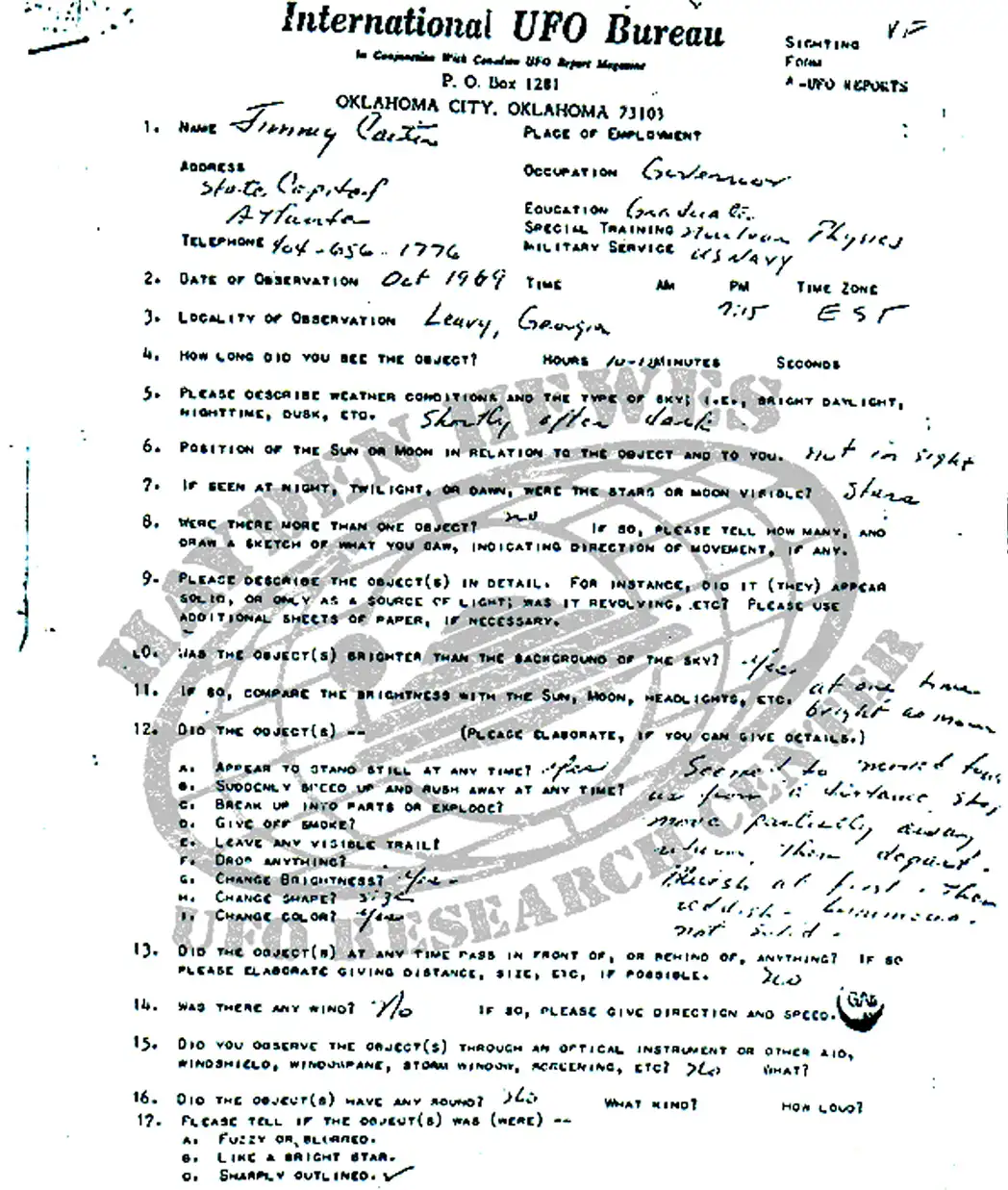
On the questionnaire, Carter identified the location as Leary, Georgia. He listed the date as October 1969 and the time as approximately 7:15 P.M. EST.
Carter said the object remained visible for about 10 to 12 minutes. He reported a single object, no sound, and described it as sharply outlined and self-luminous.
The most memorable part of the report is the object's changing appearance. Carter described it as bluish at first, then reddish, then luminous, but not solid. At one point, he compared its brightness to the moon.
He also described apparent movement. The object seemed to come closer, move away, return closer, and then move away again.
Carter estimated the distance only with difficulty. The surviving form gives a range of roughly 300 to 1,000 yards.
The People Carter Said Were With Him
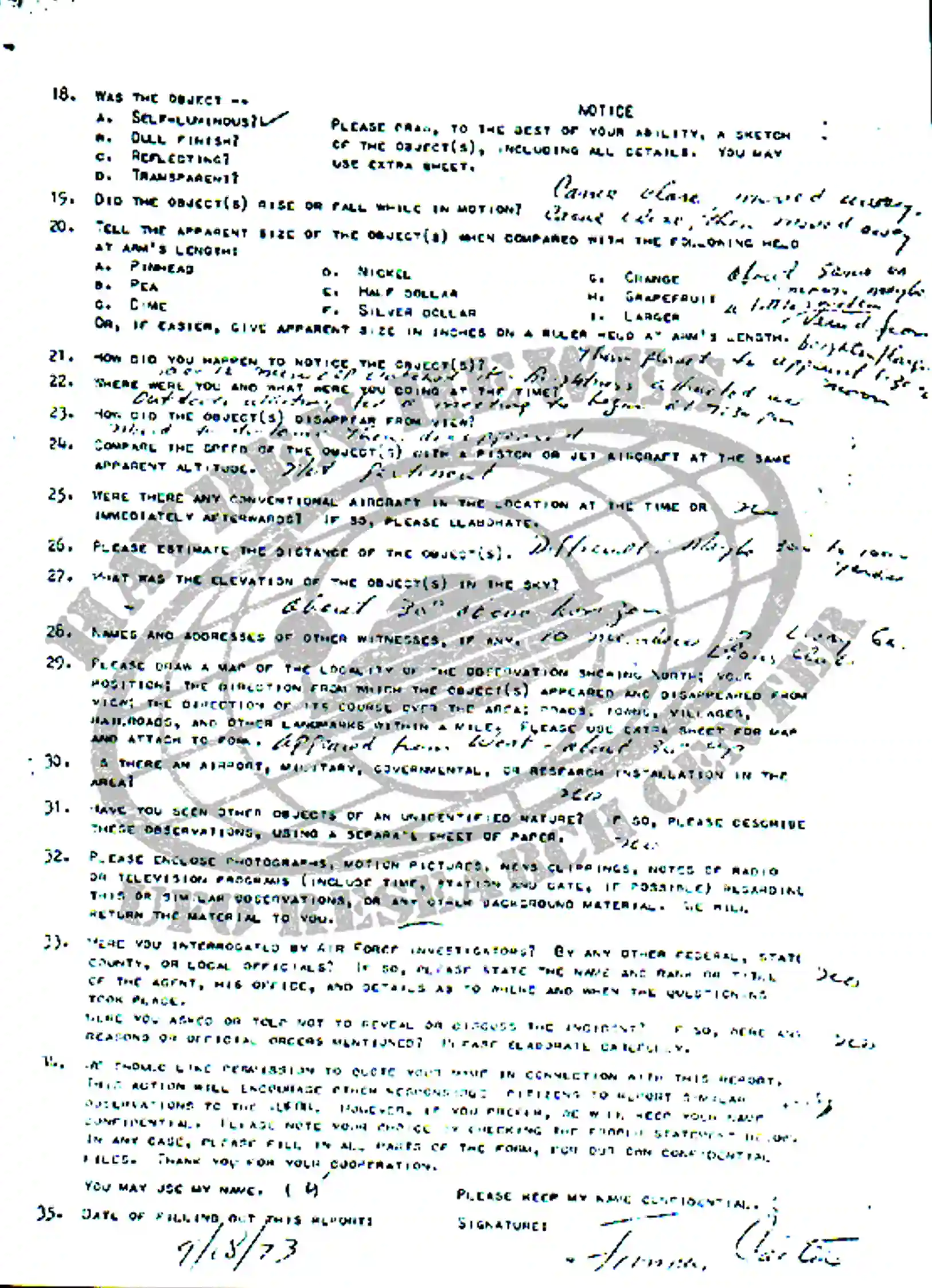
Carter did not describe himself as the only observer. On the questionnaire he listed other witnesses as 10 members of the Leary Lions Club.
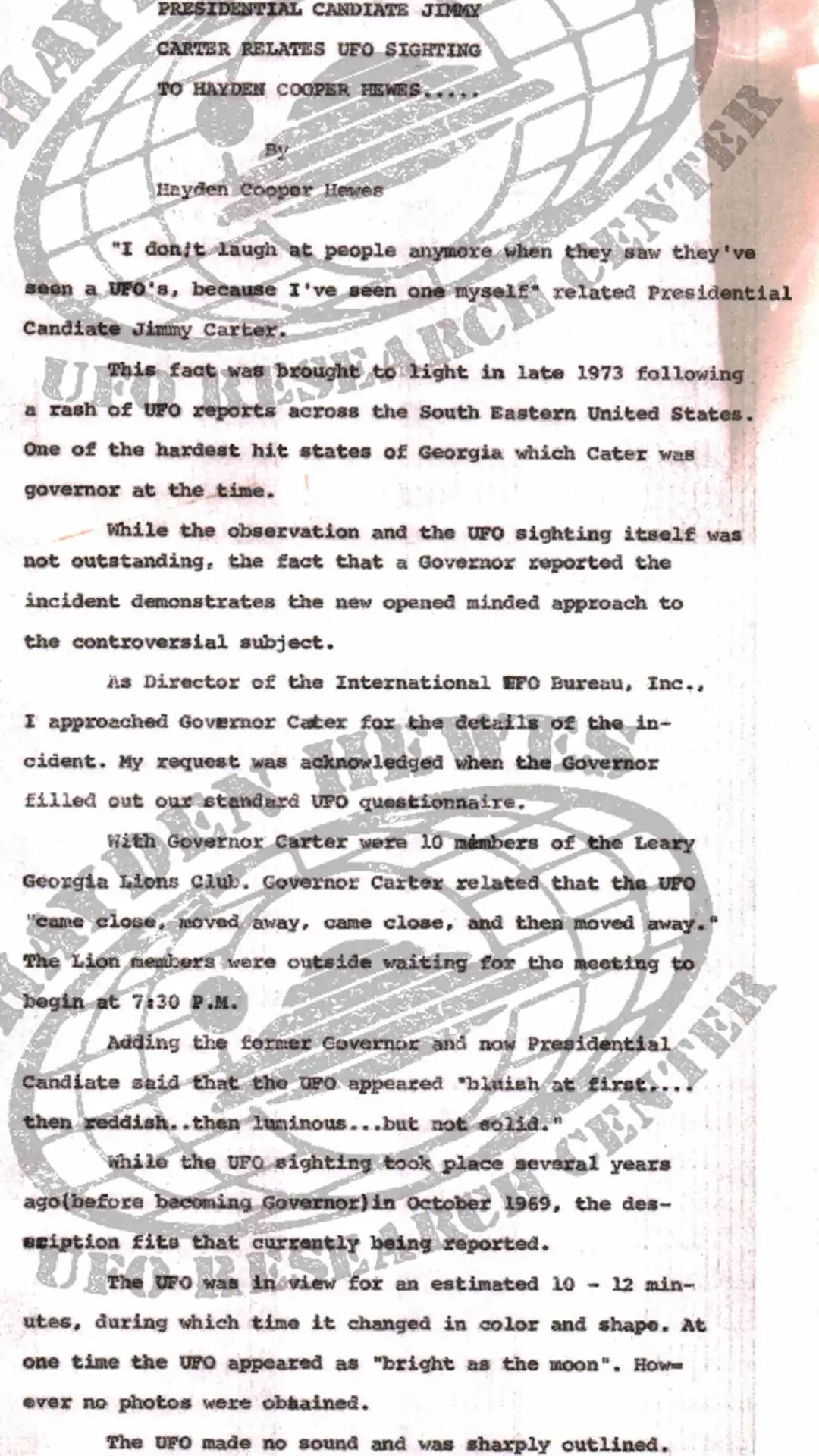
Hewes later wrote that the group was outside waiting for the Lions Club meeting to begin. In his articles, he repeatedly used the presence of other people as part of the public account of the sighting.
Carter also reported that no photographs were obtained. Hewes's later account said no federal, state, or local authority had investigated the event at the time.
Those details would become important when the case was revisited years later. A sighting reported by a public official was notable, but the surviving file still depended heavily on Carter's own written description.
One Case, Two Dates
Carter's handwritten report says the sighting occurred in October 1969. Hewes's early articles repeated that date.
A later document in the archive presents a different date. Working with researcher Robert Sheaffer, Hewes wrote that the critical step in reexamining the case was recognizing that the reported month was wrong.
Sheaffer traced the Lions Club meeting to January 6, 1969.
That date change matters because the later proposed identification of the object depends on where a known bright object would have appeared in the sky that evening.
Why Hewes Considered the Report Important
Hewes did not present Carter's sighting as one of IUFOB's most extraordinary cases.
In his own writing, he said the observation itself was not outstanding. What interested him was that a governor was willing to put his experience in writing and return a UFO report to a civilian research organization.
Hewes wrote that publicity around the case could show a more open approach to the subject and perhaps encourage other witnesses to report what they had seen.
That theme continued after Carter became a presidential candidate. Hewes's article opened with Carter's statement that he no longer laughed at people who said they had seen a UFO because he had seen one himself.
The Story Returns in 1977
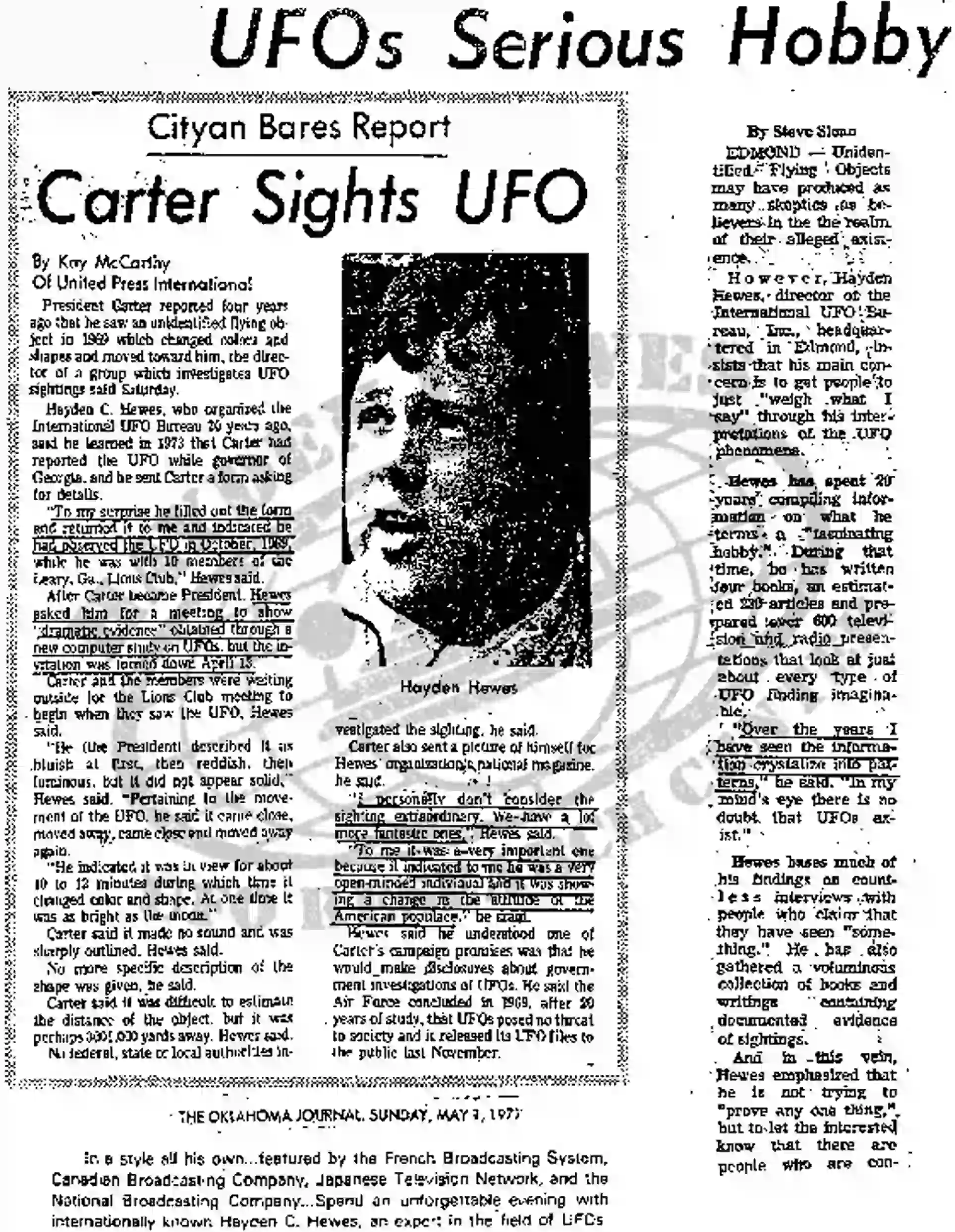
After Carter became President, the old report returned to the news. A 1977 newspaper article again described the 1969 sighting through Hewes and the questionnaire preserved by IUFOB.
Hewes again summarized the changing colors, apparent movement, 10-to-12-minute duration, lack of sound, and Carter's estimate of the object's distance.
But Hewes also put the case in perspective. He said he did not personally consider the sighting extraordinary and that IUFOB had more unusual cases.
For Hewes, Carter's willingness to report the incident remained more important than the strangeness of the sighting itself.
The Later Venus Identification
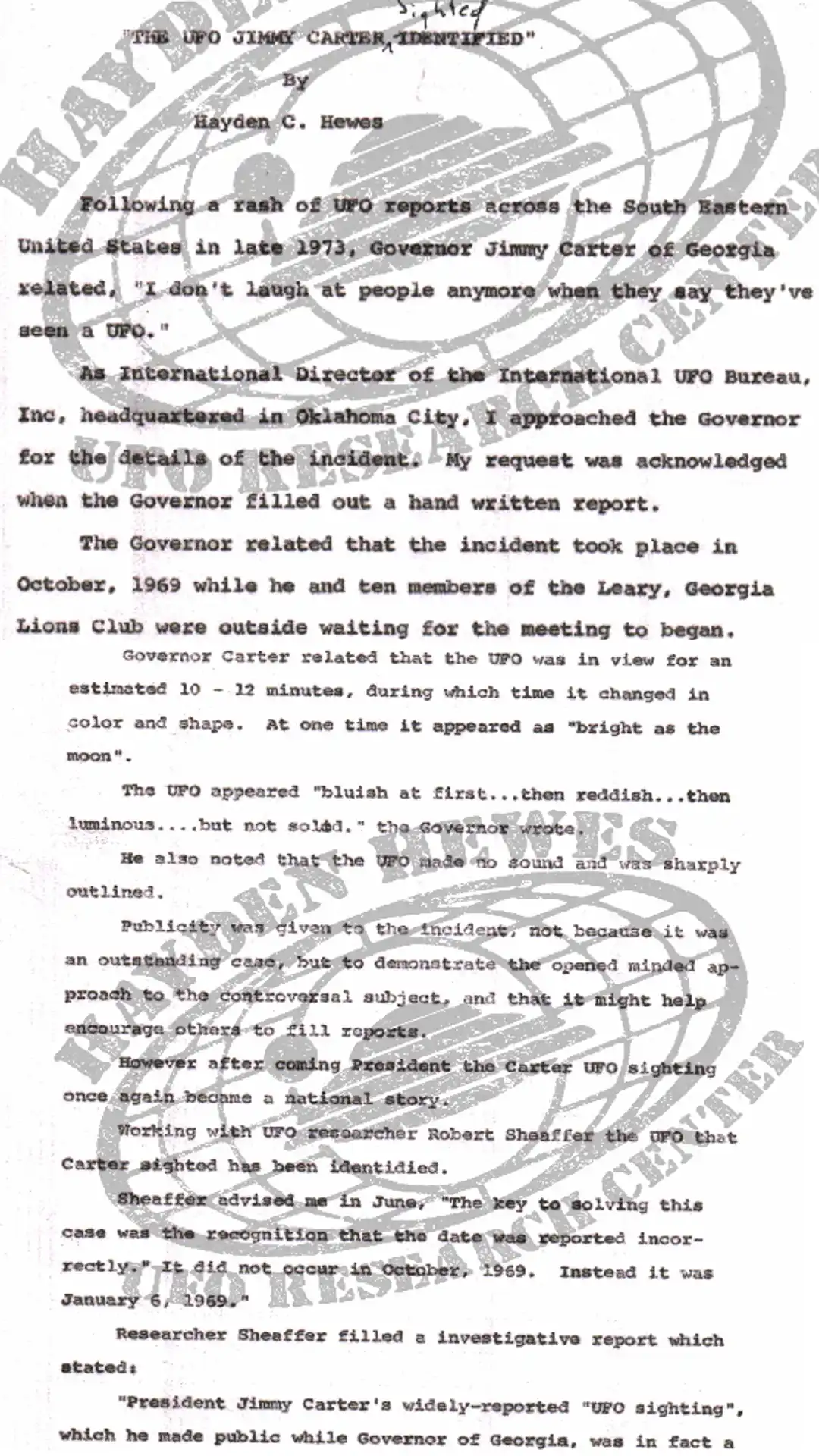
The Hewes Archive does not stop with Carter's original report. It also preserves a later attempt to explain the sighting.
In The UFO Jimmy Carter “Identified”, Hewes wrote that researcher Robert Sheaffer had reexamined the case and concluded that the sighting took place on January 6, 1969 rather than in October.
According to the investigation described by Hewes, Carter was in Leary for a Lions Club meeting at about 7:15 P.M. and reported the object in the western sky at roughly 30 degrees elevation.
Sheaffer argued that this position closely matched Venus, which he placed in the west-southwest at about 25 degrees elevation. Hewes's paper therefore presented the case as a misidentification of Venus.
That is the explanation preserved in the later IUFOB material. It is not what Carter wrote on the original 1973 questionnaire, and it was reached through a later reconstruction of the date and circumstances.
What Happened to the Other Witnesses?
The later investigation also tested one of the strongest parts of the original account: Carter's statement that ten Leary Lions Club members were present.
Hewes's later paper says attempts to locate ten additional witnesses were unsuccessful. People in Leary remembered Carter's visit, but those interviewed generally did not remember a UFO sighting associated with the meeting.
Sheaffer did locate one person connected to the event. Fred Hart, identified in the paper as the 1969 president of the club, faintly recalled standing outside with Carter and watching a light in the sky.
That recollection supports the basic idea that Carter and another person watched a light. It does not, by itself, establish what the light was.
Why the Sighting Remains Interesting
Carter's report is more substantial than a secondhand anecdote. IUFOB asked him directly for details, and Carter returned a signed, handwritten questionnaire.
He described a sighting lasting several minutes, changes in color, apparent movement toward and away from the observers, strong brightness, no sound, and an object he considered sharply outlined and self-luminous.
He also named a group of other people who were present.
Those details explain why the report continued to attract attention even though Hewes did not rank it among IUFOB's most unusual cases.
Why the Later Identification Matters
The archive also contains reasons to be cautious about treating the report as evidence of an unknown craft.
The date written on Carter's form was later challenged by a search of Lions Club records. Once the event was placed on January 6, Sheaffer argued that the reported direction and elevation closely matched Venus.
The original ten additional witnesses were not recovered as a group for detailed interviews. The one person later located only faintly remembered watching a light with Carter.
There were no photographs in the file, and the surviving IUFOB material does not contain a contemporary physical record of an unknown craft.
For those reasons, the later Hewes paper treated the sighting as identified rather than unexplained.
What the Hewes Files Establish
The documents establish that Hayden Hewes contacted Jimmy Carter in 1973 and asked him to report his experience directly.
Carter completed and signed the IUFOB form. He described a bright, silent object near Leary, Georgia, visible for roughly 10 to 12 minutes and changing in color and apparent position.
Hewes later publicized the report while also saying that the case itself was not especially extraordinary.
The same archive also preserves a later investigation that changed the sighting date and argued that Carter had seen Venus.
Was Carter's report an observation of something truly unidentified, or a sincere misidentification of an unusually bright object in the evening sky?
The archive preserves both stages of the story: the original report and the later attempt to resolve it.
A Report, Then a Reexamination
The Carter file is valuable because it shows how a UFO case can change over time.
In 1973, IUFOB obtained a direct written account from a sitting governor. The report was publicized because Carter was willing to put his name behind what he had seen.
Years later, the same organization preserved research arguing that the date had been wrong and that the object could be identified as Venus.
Rather than forcing the documents into one conclusion, the Hayden C. Hewes Archive allows both parts of that history to remain together.
Read Carter's report. Compare Hewes's articles. Follow the later investigation. Draw your own conclusion.