
The Wow Signal
Headlines Say It’s Been Solved. But Has It?
Author: Sherry Ramanathan
On August 15, 1977, the Ohio State University’s Big Ear Radio Telescope picked up the most powerful signal it would ever detect over decades of observations: The Wow Signal.
As you have probably guessed from its name (taken from the word Wow! written on the computer printout), the Wow Signal was no ordinary signal. It was an extremely powerful signal coming from a protected area of the radio spectrum set aside by international agreement for radio astronomy. It lasted at least 72 seconds and, due to the nature of the signal, it did not appear to be of human origin.
Ohio State’s Big Ear Radio Telescope was part of the Search for Extraterrestrial Intelligence (SETI) program from 1973 to 1995. Astronomer Jerry R. Ehman discovered the anomaly a few days after it was recorded while reviewing the data. His handwriting is on the original printout and is responsible for the signal’s name.
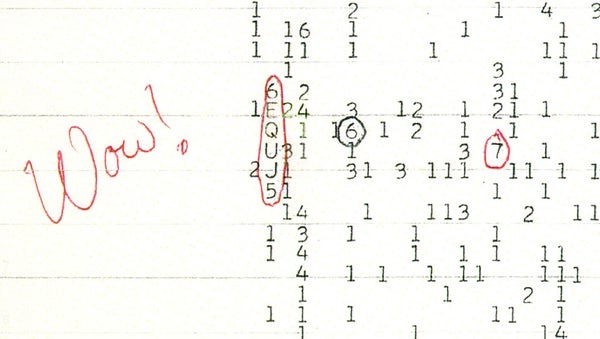
Image 1: The computer printout of the Wow Signal. The string 6EQUJ5 circled is the signal’s intensity.
As to be expected, the Wow Signal has always been divisive in the SETI community. One-off signals that can’t be completely explained are common. Usually they show hints of instrument malfunction or human-made radio transmission. The Wow Signal, however, had previously determined features of extraterrestrial origin.
Physicists at Cornell University had speculated that if an extraterrestrial civilization wanted to attempt communication by radio signals, it would be reasonable for them to do so using a frequency of 1420 megahertz. This frequency is naturally emitted by hydrogen, the simplest and most common element in the universe. It’s sensible to conclude it would be familiar to any technologically advanced civilization, human or otherwise.
A key distinction between natural and artificial signals is that the latter tend to be narrowband, i.e., focused over a very small section of frequencies as opposed to being spread over a large range (broadband). Not only was the Wow Signal a narrowband signal, it was right at 1420 MHz, but 30 times more intense than background noise. And as mentioned above, this is a protected section of the radio spectrum.
Several attempts have been made to detect the Wow Signal again, but none were successful. Various attempts have been made to explain the signal and theories have been presented. Many natural theories such as radiation from a comet, radio interference produced by humans, and a plethora of others, have been investigated. Of course, the theory the UFO community really wants to believe is that it’s a message from an advanced extraterrestrial civilization. None of these explanations has been validated.
Other attempts have been made to find similar signals. A total of 8 Wow -like signals were found in archival data from the Arecibo Observatory. The narrowband radio emissions were either at or extremely close to the 1420 MHz frequency and were recorded in about an hour of observing time during brief scans of small, disparate patches of sky between February and May 2020. But though they were Wow -like, their intensity was anywhere from 50 to 100 times less.
So many signals in such a short time suggest a natural origin. The plentiful 1420 MHz emitting hydrogen clouds are an obvious answer. It’s been suggested that the Big Ear was pointed at such a cloud.
For the hydrogen cloud to emit a radio burst, it would have to be bombarded by a powerful source of radiation. For it to emit a radio burst as intense as the Wow Signal, the radiation would have to be extreme. It would require a directed burst of X-rays and gamma rays. The latest explanation is that a flare from a magnetar, a kind of neutron star that spins like a pulsar and also has a magnetic field, could possibly provide this. This type of radio emission is known as a maser, the radio equivalent of a laser. In this case, it would be a type of hydrogen maser. They are rare but have been observed for several decades. However, none at 1420 MHz have been detected. In other words, it’s not impossible, but unlikely.
Another earlier explanation is that the signal originated from comets. However, the comets in question, 266P/Christensen and 335P/Gibbs, were not in the correct location in the sky at the time the Wow signal was detected. Other issues with this explanation are that the hydrogen density and resulting radio emissions are usually extremely weak, and not necessarily in such a narrow band.
Essentially, the Wow Signal mystery has yet to be solved, though recent headlines may state otherwise.
