
Before he became the 39th president of the United States, Jimmy Carter put his own UFO sighting on the record. The signed report is preserved in the Hayden C. Hewes Archive.
On September 18, 1973, Georgia Governor Jimmy Carter signed a UFO sighting report for the International UFO Bureau.
Four years later, he would become president of the United States. His report placed him in a unique position in American history as the first U.S. president known to have formally reported a UFO sighting.
The National Archives now includes Carter’s 1973 report among the UFO and UAP records held by the Jimmy Carter Presidential Library.
The International UFO Bureau preserves its own record of the case in the Hayden C. Hewes Archive, including correspondence with Carter, his handwritten report, news coverage, and later research into what he may have seen.
Hayden C. Hewes wrote to Carter on September 14, 1973, asking him to provide details about an unusual light he had seen several years earlier near Leary, Georgia.
Carter responded four days later.
In his handwritten report, he described a bright, silent object visible for about 10 to 12 minutes. He said its color appeared to shift from blue to red. It seemed to move closer, then farther away. Carter listed ten members of the Leary Lions Club as other witnesses.
There were no photographs.
There was, however, a signed report from a sitting governor describing an object he could not identify.
Carter continued to speak about the sighting as he entered national politics.
During the 1976 presidential campaign, Carter said he supported making government information about UFO sightings available to the public and to scientists. His comments brought the question of government UFO records into a presidential campaign.
His interest did not disappear after the election.
In 1977, Carter’s science adviser, Dr. Frank Press, asked NASA Administrator Robert Frosch to consider whether new findings justified another review of UFO reports. NASA later concluded that it did not have enough evidence to establish a new research program.
The record is significant because a man who had personally reported an unexplained sighting later reached the presidency and had the authority to ask federal agencies what they knew.
The Bureau’s file did not end with Carter’s account.
Carter originally placed the sighting in October of 1969. Researcher Robert Sheaffer later traced the Lions Club meeting to January 6, 1969. Based on that date, the reported direction of the object, and astronomical conditions, Sheaffer proposed that Carter had seen Venus.
Hewes preserved that finding with the rest of the case.
Efforts to locate other witnesses produced limited results. One Lions Club member recalled watching a light with Carter, although his memory of the event was faint.
Those limits are part of the file as well.
The archive preserves the original report, the later investigation, and the questions that remained.
Carter’s case became part of a larger question that remains active today: how much government information about UFOs and UAP should be available for public research?
That question now has a formal place in federal law.
The 2024 National Defense Authorization Act directed the National Archives to establish an Unidentified Anomalous Phenomena Records Collection. Federal agencies were required to identify UAP records in their custody and prepare them for transfer and public disclosure, subject to permitted national security and privacy restrictions. The National Archives continues to add records to that collection as agencies transfer them.
The process taking place today has roots that reach back decades.
Jimmy Carter was asking questions about access to UFO records nearly half a century ago.
The Hayden C. Hewes Archive preserves the International UFO Bureau’s part of that history.
The original correspondence.
Carter’s handwritten and signed report.
The Bureau’s coverage of the case.
The later investigation.
Together, these records allow researchers and the public to follow the case from Carter’s own account through later attempts to explain what he saw.
They also show why preserving original records matters. Historical questions can be revisited when the document survives.
NASA Administrator Says Declassified UAP Files Show Real Unexplained PhenomenaA USA Herald article reports that NASA Administrator Jared Isaacman addressed the Trump administration’s recent UAP disclosure effort, saying the newly released files show “real unexplained phenomena,” but not crashed spacecraft or alien bodies.
According to the article, Isaacman told Fox News Digital that the material now being surfaced includes reports and records that federal agencies had kept in files for years. The article frames his comments around the release of declassified UAP material connected to military footage, astronaut accounts, and reports from intelligence and defense personnel.
The Trump administration has released two waves of declassified UAP files as part of a broader transparency push. It also reports that agencies have been directed to search internal databases for older reports involving unexplained aerial activity. According to the article, additional releases from intelligence agencies, including the CIA, may still be ahead.
USA Herald describes the newly surfaced material as including infrared footage from 2023 that appears to show a U.S. F-16 shooting down a diamond-shaped object over Lake Huron. The files include reports of unidentified aerial objects near military operations in places such as Iran, Syria, Iraq, Greece, and other areas across the Middle East.
The article also points to Apollo and Gemini-era astronaut accounts describing strange lights and unidentified objects seen from space. It says the broader file set includes testimony from intelligence officers and military pilots who encountered phenomena during active operations or training exercises that they could not explain at the time.
Isaacman is quoted in the article as saying that government agencies did not take the issue seriously enough in the past. He reportedly connected the new search effort to President Trump’s direction for agencies to go back through their files, search their databases, and bring unresolved material forward.
Isaacman noted the extent of today’s sensor coverage, explaining that cameras and detection systems now span everything from consumer devices to military aircraft with sophisticated capabilities. Isaacman noted that broader sensor coverage means more unusual events will be captured, but interpretation becomes harder when something is recorded from only a few angles or within a combat environment.
He reported no knowledge of alien bodies or spacecraft within the released material. Instead, he described the disclosure effort as bringing forward old observations from decades past, including reports from adversaries and allies that had been documented and then left buried in files.
Isaacman characterized the release as a kind of “citizen science,” inviting the public to examine the files and help interpret the material. The article frames this as part of a larger push for public accountability and transparency around UAP records.
The report also connects the UAP discussion to NASA’s broader search for life beyond Earth. Isaacman reportedly said that Mars sample-return efforts could have a strong chance of finding evidence of former microbial life. He also pointed to Titan and Europa as locations where scientists are interested in possible biosignatures or microbial life.
The article closes by noting that the disclosure effort is ongoing and that more UFO and UAP files may be released in future batches. Its central focus is not a claim that extraterrestrial life has been confirmed, but that unexplained aerial phenomena were documented, stored away, and are now being brought into public view through the current disclosure process.
Source noted for review: USA Herald article titled “NASA Boss Breaks Silence on Trump’s UFO Bombshell: ‘We Kept It Buried in a File Somewhere.’”
A recent Fox News report, carried through MSN, says filmmaker Dan Farah believes the FBI is taking an active role in looking into reports of mystery objects near U.S. nuclear facilities.
The article connects the claim to Farah’s work on The Age of Disclosure, a documentary project focused on government secrecy, UAP-related testimony, and the push for more public information about unidentified aerial phenomena. According to the report, Farah said the FBI is “leading the charge” and is pursuing the issue aggressively.
The article frames the nuclear-facility angle as one of the more serious parts of the broader UAP discussion. Reports involving nuclear sites carry obvious security concerns, especially when they involve restricted airspace, sensitive infrastructure, or repeated observations near facilities that are supposed to be closely monitored.
The coverage also places Farah’s comments within the larger disclosure conversation now unfolding around government records, military footage, congressional attention, and public pressure for more transparency. Rather than focusing only on sightings themselves, the article emphasizes the question of whether federal agencies know more than they have publicly released.
Farah is presented in the article as someone arguing that the issue has moved beyond speculation and into a national-security conversation. The report describes him as saying that officials and agencies are paying attention behind the scenes, particularly where nuclear facilities are concerned.
The article does not present a newly released FBI file or a direct public statement from the Bureau in the quoted summary. Instead, it reports Farah’s claim about the FBI’s interest and activity. The main takeaway is that the nuclear-facility issue remains part of the current UAP disclosure debate and is being discussed in mainstream media as a matter involving federal attention.
This story fits into a larger pattern of recent coverage about UAPs, government transparency, and questions about what information is being held by federal agencies. The nuclear-site detail makes the report especially notable, because it raises concerns that go beyond curiosity and into public safety, airspace security, and infrastructure protection.
Source noted for review: Fox News/MSN report titled “FBI leading push to uncover truth about mystery objects near US nuclear facilities, filmmaker says.”
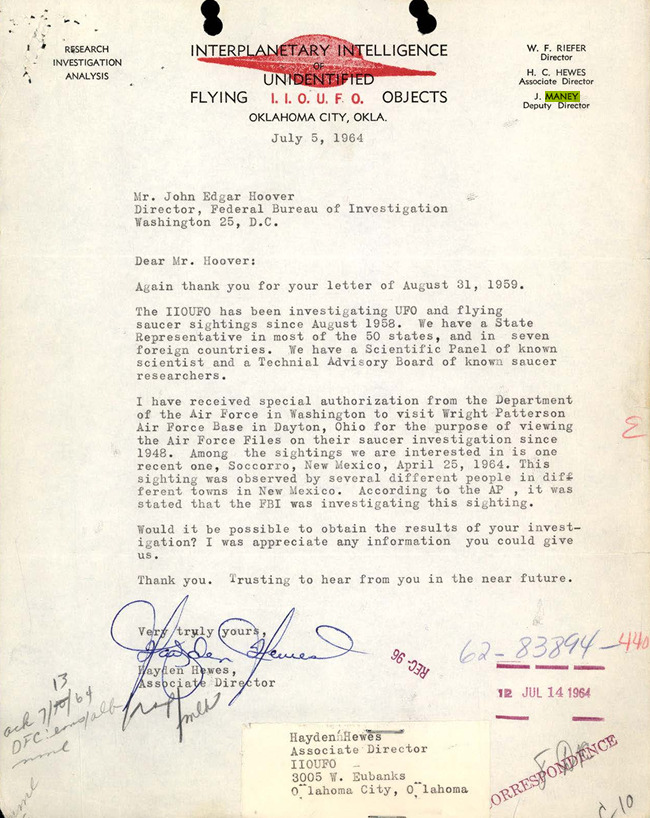
Buried within a recently published Department of War UFO file is the forgotten story of two Oklahoma teenagers who helped build one of America’s earliest civilian UFO research organizations, decades before the internet transformed how information traveled across the country.
The file, titled “65_HS1-834228961_62-HQ-83894_Section_9,” contains federal correspondence referencing Hayden C. Hewes, James Maney, and the Interplanetary Intelligence of Unidentified Flying Objects (IIOUFO), a research organization founded in Oklahoma City in 1957. Over time, the IIOUFO would evolve into what is known today as the International UFO Bureau (IUFOB).
The records provide an independently documented glimpse into the organization’s early years and the growing visibility it achieved during the formative era of UFO research in America.
Long before congressional hearings, viral military footage, or social media debates, teenage researchers in Oklahoma were already organizing nationwide reporting networks dedicated to investigating unexplained aerial sightings. Hayden Hewes founded the IIOUFO while still in his teens, and James Maney joined him as deputy director at only fourteen years old.
By combining surviving newspaper coverage from the period with preserved organizational archives and recently released federal records, a documented timeline is established for the organization’s early growth. At a time when most Americans were only beginning to hear the phrase “flying saucer,” the Oklahoma-based group was already publishing research materials, organizing skywatch efforts, and corresponding with witnesses and researchers across the country.
What makes the story especially remarkable is the era in which it unfolded. The young founders were building research and communication networks years before email, digital databases, or online communities existed.
Witness reports arrived through mailed letters and telephone calls. Photographs, newsletters, typed documents, and volunteer observer posts became the backbone of early investigative efforts. Surviving records show that the IIOUFO was already developing structured reporting systems during a period when nearly all civilian UFO research relied entirely on grassroots organization and public participation.
Among the most historically significant documents in the file is a July 5, 1964 letter written by Hayden Hewes to FBI Director J. Edgar Hoover. In the correspondence, Hewes states that he had received authorization from the Department of the Air Force to visit Wright-Patterson Air Force Base in Dayton, Ohio. The purpose for the visit was for Hayden to personally review Air Force files related to unidentified flying object investigations dating back to 1948.
Additional archival material preserved within the IUFOB collection includes a June 22, 1964 response from the Department of the Air Force confirming that Project Office personnel at Wright-Patterson would welcome Hewes’ visit and arrange access to files concerning unidentified flying objects. Records and video preserved within the IUFOB archive further indicate that Hewes did in fact make the visit.
What followed afterward would further elevate the organization’s prominence. Correspondence preserved within the IUFOB archive shows that Hayden Hewes’ visit to Wright-Patterson Air Force Base led to continued communication with figures directly involved in the United States government’s early UFO research efforts during the 1960s.
Among the surviving materials is correspondence from Major Hector Quintanilla, the U.S. Air Force officer who served as head of Project Blue Book, the government’s official UFO investigation program during one of the most active periods in modern UFO history. In the letter, Quintanilla references ongoing discussion regarding unidentified flying objects and offers assistance to the IIOUFO following Hewes’ Wright-Patterson visit.
The correspondence reflects the degree of visibility and credibility the young organization had achieved during its formative years.
Historically, the IIOUFO occupies a unique place within the post-1947 flying saucer era in America. The organization was among the earliest known civilian UFO research groups established in the United States during the first major wave of public interest surrounding unidentified aerial phenomena.
Federal correspondence contained within the Department of War files identifies Hewes as Associate Director of the IIOUFO and references communication involving UFO-related reports and publications. Additional documents identify James Maney in connection with UFO research activity while still only a teenager in Oklahoma City. Together, the records help document the organization’s early development and growing visibility during the late 1950s and early 1960s.
Unlike many early UFO organizations that eventually disappeared, the original research effort founded in Oklahoma City continued evolving over the decades. The IIOUFO later became known as the International UFO Bureau while maintaining continuity from its original 1957 founding.
Preserved archives, historical correspondence, newspaper coverage, and federal records now help document that organizational lineage across nearly seventy years of operation. The survival of those materials provides an unusually detailed historical window into the early civilian UFO movement in America.
For current IUFOB leadership, the significance of the records is rooted less in sensationalism and more in preservation, continuity, and overlooked American history.
“These records help document a real and often forgotten part of Oklahoma history,” said IUFOB CEO Mindy Tautfest. “The files show that organized civilian UFO research was already taking shape here in Oklahoma during the 1950s. The material preserved within our archive continues to provide important historical context for how these early organizations operated, communicated, and evolved over time.”
Now approaching seventy years since its founding, the International UFO Bureau continues operating from Oklahoma while preserving historical UFO archives and developing modern investigative and reporting systems focused on unidentified aerial phenomena. What began as a small research effort organized by Oklahoma teenagers in 1957 has grown into one of the longest-running UFO research organizations in the United States.
Intelligence Brief: Pentagon UAP Briefings Added in NDAA – MeriTalkThe recent report from MeriTalk, a leading government IT and contracting news source, has sparked widespread interest in the UFO community. The headline “Pentagon UAP Briefings Added in NDAA” indicates that the United States Department of Defense (DoD) will now include Unidentified Aerial Phenomena (UAP) briefings as part of their annual National Defense Authorization Act (NDAA).
This development marks a significant milestone in the government’s acknowledgment and investigation of UAP sightings. As the lead intelligence analyst for the International UFO Bureau (IUFOB), it is essential to provide a comprehensive analysis of this event.
Core Details & Observations
According to the report, the inclusion of UAP briefings in the NDAA will enable the DoD to better coordinate and share information about UAP sightings across various military branches. This move aims to improve the overall understanding of these phenomena and potentially identify patterns or connections that may have implications for national security.
The addition of UAP briefings is seen as a significant step forward, considering the previous reluctance of government agencies to acknowledge or investigate such sightings. The inclusion of this topic in the NDAA underscores the growing recognition of the importance of UAP research in the context of national defense and security.
It’s worth noting that the term “UAP” is often used interchangeably with “Unidentified Flying Object” (UFO), but the former term emphasizes the focus on the aerial phenomena rather than the object itself. This subtle distinction highlights the shift towards a more scientific approach, focusing on the observed events rather than speculative interpretations.
Scientific & Anomalous Significance
The inclusion of UAP briefings in the NDAA has significant implications for advanced physics and UAP research. By acknowledging the existence of these phenomena and encouraging further investigation, the government is implicitly recognizing the possibility that some UAP sightings may be related to emerging technologies or even extraterrestrial life.
From a scientific perspective, this development opens up new avenues for interdisciplinary research, combining expertise from fields such as astrophysics, aerodynamics, materials science, and computer simulations. The study of UAP can provide valuable insights into the nature of reality, the behavior of matter and energy, and potentially even the existence of other forms of life.
Furthermore, the incorporation of UAP briefings in the NDAA may lead to a more comprehensive understanding of the phenomena, which could have far-reaching implications for fields such as astrobiology, exoplanetary science, and SETI (Search for Extraterrestrial Intelligence).
The recognition of UAP as a legitimate area of study can also foster international cooperation and collaboration, as scientists from various countries begin to share data and theories.
In conclusion, the addition of UAP briefings in the NDAA is a significant development that marks a turning point in the government’s approach towards UAP research. As the analyst for the IUFOB, it is essential to continue monitoring this situation closely and providing in-depth analyses of any new findings or developments.
The implications of this event are far-reaching, and we can expect a flurry of scientific papers, conferences, and debate as researchers and experts delve deeper into the mysteries of UAP.
Source intelligence:
Original Report
For organizations like IUFOB, this matters for an important reason: fireballs are one of the most commonly misidentified sky events reported as possible UAP.
And lately, there has been no shortage of them.
According to recent tracking from NASA’s Skyfall database and the American Meteor Society, multiple major fireball events have occurred across North America since late 2025 and into early 2026, including notable sightings over the Maryland/Pennsylvania border, New York, Louisiana, the Indiana/Ohio border, and areas west of Florida. Several of these events generated hundreds of witness reports, with some producing sonic booms and even meteorite recovery interest.
A fireball is an exceptionally bright meteor which can be typically brighter than the planet Venus, caused when a meteoroid enters Earth’s atmosphere at extremely high speed and begins to burn and fragment. These objects can travel tens of thousands of miles per hour and may appear white, green, orange, or blue depending on composition, speed, and atmospheric interaction.
To the average observer, they can look extraordinary.
Unlike the small, brief “shooting stars” many people are familiar with, fireballs are often much brighter, visible over a wider geographic area, and sometimes loud enough to be heard after the visual event.
That last part is where many reports begin to shift from “meteor” to “something strange.”
When people report UAP, they are usually doing so in good faith. Most are simply describing something they cannot immediately identify.
Fireballs trigger that reaction because they often appear in ways that feel unfamiliar or even unnatural. Witnesses may report:
In some cases, the event is so visually dramatic that people assume it must be aircraft debris, military activity, or something beyond conventional explanation.
That does not mean witnesses are “wrong.” It means the human brain is trying to interpret an unusual event in real time, often without context.
At IUFOB, one of the most important parts of case review is separating genuinely unexplained aerial events from known sky phenomena that only appear extraordinary because of lighting, perspective, or rarity.
Fireballs sit high on that list.
That is the question many people are asking and interestingly, it is one scientists are asking too. There are a few likely reasons.
First, we are definitely better at noticing them than we used to be. Doorbell cameras, dashcams, home security systems, traffic cameras, and smartphones mean more fireballs are being captured and shared than ever before. What might have gone unseen or unreported ten years ago now becomes instantly visible across social media and local news.
Second, researchers do believe there may be a real increase in larger, more noticeable fireball events this year not just better reporting. According to recent reporting and data cited by experts, the first quarter of 2026 has shown an unusually high number of bright, widely witnessed fireballs, including events producing sonic booms and potential meteorite falls. That suggests at least part of the surge may reflect an actual uptick in larger incoming meteoroids rather than observation bias alone.
Third, there are seasonal and orbital factors. Earth constantly moves through streams of dust and debris left behind by comets and asteroids. Certain times of year simply bring us into regions of space where larger fragments are more likely to intersect with Earth’s atmosphere. Scientists also point to the “sporadic background” of meteoroids, or objects not associated with a named meteor shower, as a possible contributor to the recent increase.
In short, the recent wave of fireballs is likely the result of both improved detection and a genuine increase in larger visible events.
For civilian reporting organizations, education is part of the mission.
A healthy UAP field depends on being able to recognize what is unusual and what is simply unfamiliar.
That is why fireballs matter.
When IUFOB receives reports involving a bright object moving rapidly in a straight line, visible fragmentation, a brief duration of only a few seconds, or delayed thunder-like sounds, one of the first possibilities considered is meteor activity.
This does not diminish the witness experience. In fact, it validates it.
Many people who see a fireball are witnessing something genuinely rare and dramatic. It may not be an unexplained craft but it is still a real, memorable atmospheric event worth documenting properly.
And in some cases, fireball reports can even contribute to scientific understanding, especially when videos, timestamps, and geographic observations are preserved.
If you ever see a bright object in the sky and are unsure what it was, documentation matters.
Try to note:
Those details help investigators distinguish between:
The goal is not to explain everything away. The goal is to classify responsibly.
The recent surge in fireball sightings is a reminder of how dynamic our skies really are. It is also a reminder that not every dramatic aerial event is a UAP, and not every UAP report begins with mystery. Sometimes, it begins with a very real natural phenomenon moving at extraordinary speed through our atmosphere.
For IUFOB, that distinction is not a dismissal. It is part of disciplined investigation. In a time of heightened public awareness, understanding the difference between misidentification and true anomaly has never been more important.
Seen something unusual in the sky? Submit a structured report to IUFOB. Every well-documented observation helps improve the quality of UAP research and public understanding.
The Wow Signal: Headlines Say It’s Been Solved. But Has It?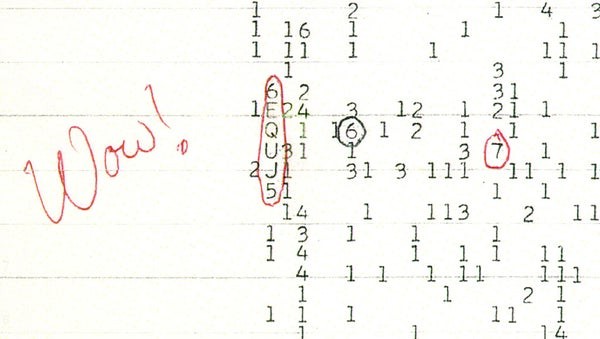
On August 15, 1977, the Ohio State University’s Big Ear Radio Telescope picked up the most powerful signal it would ever detect over decades of observations: The Wow Signal.
As you have probably guessed from its name (taken from the word Wow! written on the computer printout), the Wow Signal was no ordinary signal. It was an extremely powerful signal coming from a protected area of the radio spectrum set aside by international agreement for radio astronomy. It lasted at least 72 seconds and, due to the nature of the signal, it did not appear to be of human origin.
Ohio State’s Big Ear Radio Telescope was part of the Search for Extraterrestrial Intelligence (SETI) program from 1973 to 1995. Astronomer Jerry R. Ehman discovered the anomaly a few days after it was recorded while reviewing the data. His handwriting is on the original printout and is responsible for the signal’s name.
As to be expected, the Wow Signal has always been divisive in the SETI community. One-off signals that can’t be completely explained are common. Usually they show hints of instrument malfunction or human-made radio transmission. The Wow Signal, however, had previously determined features of extraterrestrial origin.
Physicists at Cornell University had speculated that if an extraterrestrial civilization wanted to attempt communication by radio signals, it would be reasonable for them to do so using a frequency of 1420 megahertz. This frequency is naturally emitted by hydrogen, the simplest and most common element in the universe. It’s sensible to conclude it would be familiar to any technologically advanced civilization, human or otherwise.
A key distinction between natural and artificial signals is that the latter tend to be narrowband, i.e., focused over a very small section of frequencies as opposed to being spread over a large range (broadband). Not only was the Wow Signal a narrowband signal, it was right at 1420 MHz, but 30 times more intense than background noise. And as mentioned above, this is a protected section of the radio spectrum.
Several attempts have been made to detect the Wow Signal again, but none were successful. Various attempts have been made to explain the signal and theories have been presented. Many natural theories such as radiation from a comet, radio interference produced by humans, and a plethora of others, have been investigated. Of course, the theory the UFO community really wants to believe is that it’s a message from an advanced extraterrestrial civilization. None of these explanations has been validated.
Other attempts have been made to find similar signals. A total of 8 Wow-like signals were found in archival data from the Arecibo Observatory. The narrowband radio emissions were either at or extremely close to the 1420 MHz frequency and were recorded in about an hour of observing time during brief scans of small, disparate patches of sky between February and May 2020. But though they were Wow-like, their intensity was anywhere from 50 to 100 times less.
So many signals in such a short time suggest a natural origin. The plentiful 1420 MHz emitting hydrogen clouds are an obvious answer. It’s been suggested that the Big Ear was pointed at such a cloud.
For the hydrogen cloud to emit a radio burst, it would have to be bombarded by a powerful source of radiation. For it to emit a radio burst as intense as the Wow Signal, the radiation would have to be extreme. It would require a directed burst of X-rays and gamma rays. The latest explanation is that a flare from a magnetar, a kind of neutron star that spins like a pulsar and also has a magnetic field, could possibly provide this. This type of radio emission is known as a maser, the radio equivalent of a laser. In this case, it would be a type of hydrogen maser. They are rare but have been observed for several decades. However, none at 1420 MHz have been detected. In other words, it’s not impossible, but unlikely.
Another earlier explanation is that the signal originated from comets. However, the comets in question, 266P/Christensen and 335P/Gibbs, were not in the correct location in the sky at the time the Wow signal was detected. Other issues with this explanation are that the hydrogen density and resulting radio emissions are usually extremely weak, and not necessarily in such a narrow band.
Essentially, the Wow Signal mystery has yet to be solved, though recent headlines may state otherwise.
The Ecliptic – The Path of the SunIf you’ve spent any time at all investigating UFO sightings, one thing will eventually become very clear: Planets often are mistaken for UFOs. Venus, Jupiter, and Saturn are typically the guilty parties because they are bright, sometimes very bright. When a witness reports a bright light in the sky, even if they report it moving (see FI Training Minute in this issue), planet positions are one of the first things to check.
There are several excellent software packages that can help determine if that bright light is a planet. However, sometimes finding a planet, even within the software, can be difficult. Also, there may be times when you’ll want to have an idea of whether or not a sighting might be a planet when you don’t have immediate access to software. One way to do that is to understand how planetary orbits work and how that appears to someone standing on planet earth.
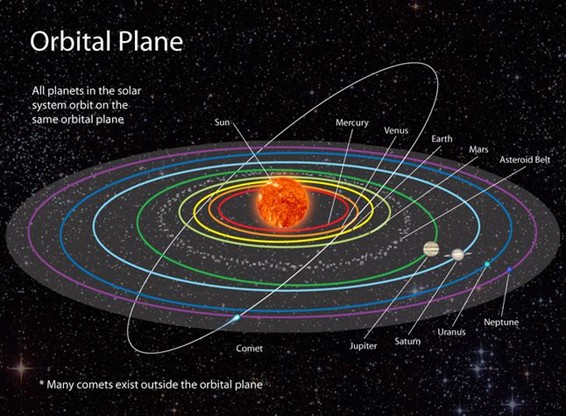
The Solar System looks like a huge flat disk (reference Image X). All eight planets orbit the Sun in the plane of this disk. The orbits are not perfectly on the same plane but they are close enough for our purposes.
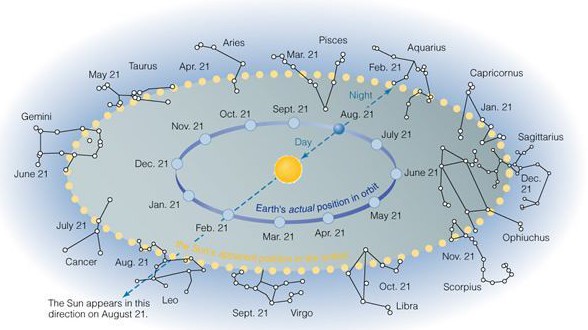
Now, pretend you’re looking up at the Sun from Earth’s surface. Depending on the date, the Sun will have a different backdrop of stars. Take a look at Image XX. Note the position of the Earth (the small blue disk) in relation to the Sun on August 21. During the daytime, if you could see the stars behind the Sun, you would see the constellation Leo. As time passes and the Earth progresses around the Sun, the background of stars behind the Sun will continue to change, progressing around the constellations of the zodiac. On September 21, you would see the constellation Virgo. On October 21, you would see the constellation Libra, and so on.
Due to the Earth’s rotation around the Sun, the Sun appears to make a path to a different area of the sky. After the passage of a year, the Sun completes the circle and is almost back where it started. The circle, or path, the Sun makes in the sky is called the ecliptic.
Because the planets orbit the Sun in almost the same plane as the Earth, they will also follow the ecliptic. It’s not exact but it’s useful for getting an idea of where they should be.
Don’t confuse the motion of the Sun along the ecliptic (caused by the Earth’s rotation around the Sun) with the Earth’s rotation on it’s axis, which causes night and day. It’s not the same path.
The orbits of Venus and Mercury are closer to the Sun than Earth’s orbit. For that reason, they will always be near the Sun, very close to the ecliptic and near the sunrise and sunset.
The planets with orbits outside Earth’s orbit, including Saturn and Jupiter, will move across the whole ecliptic.
The easiest way to find the ecliptic is to install a star map app on your phone. Most of these maps will show the ecliptic and as long as you can see the ecliptic, you can find the planets.
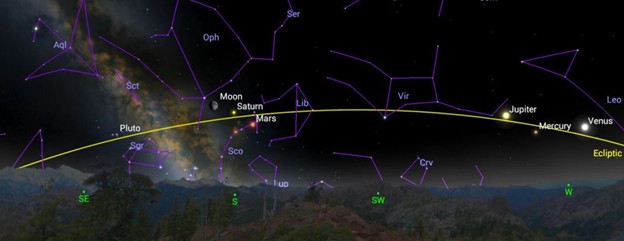
Another way is to keep track of the Sun and the Moon. The Sun will always be on the ecliptic. The Moon’s orbit tilts approximately 5 degrees off the ecliptic so it will always be within 5 degrees of it. That’s about the width of three fingers held together at the end of your outstretched arm.
Alpha Centauri Star SystemAuthor: Sherry Ramanathan
The Alpha Centauri Star System is the closest star system to our Sun. It contains three stars. The dimmest star, which also happens to be the star closest to earth other than our own Sun, is Proxima Centauri (also known as Alpha Centauri C) at 4.25 light years away. The other two stars, Alpha Centauri A and B, form a “close binary system”. A binary star system simply means the system consists of two stars that revolve around each other. The Alpha Centauri binary system is considered ‘close’ because the two stars are currently separated by only 23 Astronomical Units. An Astronomical Unit (AU) is the average distance between the Earth and the Sun or about 93 million miles (150 million kilometers). One AU times 23 is a little bit greater than the distance between Uranus and the Sun.
While A and B revolve around each other, Proxima Centauri revolves around both A and B, making Alpha Centauri a triple star system.
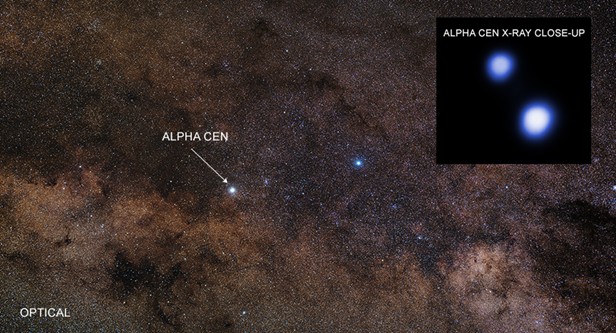
Why It’s Important: It’s a triple star system containing the closest star to our Sun and has one known exoplanet.
Alpha Centauri is interesting for many reasons but for our purposes, two things stand out. Alpha Centauri A is the same type of star as our Sun and Proxima Centauri has a potentially habitable exoplanet. In other words, the star closest to the Sun has a planet that is similar to Earth. The planet sits in an orbital zone that could allow liquid water to exist, a key ingredient for life on Earth.
Proxima Centauri is a red dwarf star, which is cooler and redder than our Sun and the planet, Proxima b, orbits extremely close to it. One year on Proxima b is only 11 days on Earth. Although Proxima b orbits within the habitable zone of Proxima Centauri, it is not known whether it has an atmosphere, which would impact habitability. Proxima Centauri is a flare star with intense emission of electromagnetic radiation that could strip an atmosphere off the planet.
At this point, it is unknown whether life exists on Proxima b. Lifeforms on this planet would have to withstand the cooler conditions and electromagnetic radiation of the red dwarf star. However, if life does exist, at 4.25 light years away, it’s considered close enough for 2-way communication.