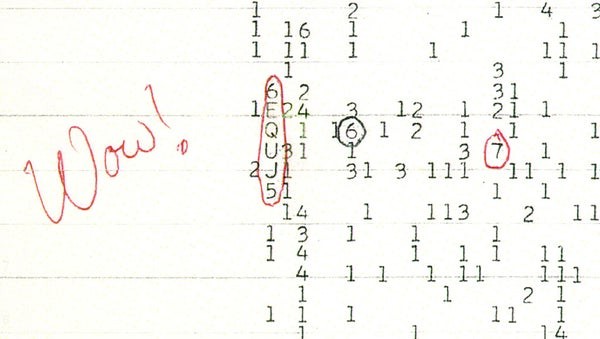
The computer printout of the Wow Signal. The string 6EQUJ5 circled is the signal’s intensity.
For organizations like IUFOB, this matters for an important reason: fireballs are one of the most commonly misidentified sky events reported as possible UAP.
And lately, there has been no shortage of them.
According to recent tracking from NASA’s Skyfall database and the American Meteor Society, multiple major fireball events have occurred across North America since late 2025 and into early 2026, including notable sightings over the Maryland/Pennsylvania border, New York, Louisiana, the Indiana/Ohio border, and areas west of Florida. Several of these events generated hundreds of witness reports, with some producing sonic booms and even meteorite recovery interest.
A fireball is an exceptionally bright meteor which can be typically brighter than the planet Venus, caused when a meteoroid enters Earth’s atmosphere at extremely high speed and begins to burn and fragment. These objects can travel tens of thousands of miles per hour and may appear white, green, orange, or blue depending on composition, speed, and atmospheric interaction.
To the average observer, they can look extraordinary.
Unlike the small, brief “shooting stars” many people are familiar with, fireballs are often much brighter, visible over a wider geographic area, and sometimes loud enough to be heard after the visual event.
That last part is where many reports begin to shift from “meteor” to “something strange.”
When people report UAP, they are usually doing so in good faith. Most are simply describing something they cannot immediately identify.
Fireballs trigger that reaction because they often appear in ways that feel unfamiliar or even unnatural. Witnesses may report:
In some cases, the event is so visually dramatic that people assume it must be aircraft debris, military activity, or something beyond conventional explanation.
That does not mean witnesses are “wrong.” It means the human brain is trying to interpret an unusual event in real time, often without context.
At IUFOB, one of the most important parts of case review is separating genuinely unexplained aerial events from known sky phenomena that only appear extraordinary because of lighting, perspective, or rarity.
Fireballs sit high on that list.
That is the question many people are asking and interestingly, it is one scientists are asking too. There are a few likely reasons.
First, we are definitely better at noticing them than we used to be. Doorbell cameras, dashcams, home security systems, traffic cameras, and smartphones mean more fireballs are being captured and shared than ever before. What might have gone unseen or unreported ten years ago now becomes instantly visible across social media and local news.
Second, researchers do believe there may be a real increase in larger, more noticeable fireball events this year not just better reporting. According to recent reporting and data cited by experts, the first quarter of 2026 has shown an unusually high number of bright, widely witnessed fireballs, including events producing sonic booms and potential meteorite falls. That suggests at least part of the surge may reflect an actual uptick in larger incoming meteoroids rather than observation bias alone.
Third, there are seasonal and orbital factors. Earth constantly moves through streams of dust and debris left behind by comets and asteroids. Certain times of year simply bring us into regions of space where larger fragments are more likely to intersect with Earth’s atmosphere. Scientists also point to the “sporadic background” of meteoroids, or objects not associated with a named meteor shower, as a possible contributor to the recent increase.
In short, the recent wave of fireballs is likely the result of both improved detection and a genuine increase in larger visible events.
For civilian reporting organizations, education is part of the mission.
A healthy UAP field depends on being able to recognize what is unusual and what is simply unfamiliar.
That is why fireballs matter.
When IUFOB receives reports involving a bright object moving rapidly in a straight line, visible fragmentation, a brief duration of only a few seconds, or delayed thunder-like sounds, one of the first possibilities considered is meteor activity.
This does not diminish the witness experience. In fact, it validates it.
Many people who see a fireball are witnessing something genuinely rare and dramatic. It may not be an unexplained craft but it is still a real, memorable atmospheric event worth documenting properly.
And in some cases, fireball reports can even contribute to scientific understanding, especially when videos, timestamps, and geographic observations are preserved.
If you ever see a bright object in the sky and are unsure what it was, documentation matters.
Try to note:
Those details help investigators distinguish between:
The goal is not to explain everything away. The goal is to classify responsibly.
The recent surge in fireball sightings is a reminder of how dynamic our skies really are. It is also a reminder that not every dramatic aerial event is a UAP, and not every UAP report begins with mystery. Sometimes, it begins with a very real natural phenomenon moving at extraordinary speed through our atmosphere.
For IUFOB, that distinction is not a dismissal. It is part of disciplined investigation. In a time of heightened public awareness, understanding the difference between misidentification and true anomaly has never been more important.
Seen something unusual in the sky? Submit a structured report to IUFOB. Every well-documented observation helps improve the quality of UAP research and public understanding.
The Wow Signal: Headlines Say It’s Been Solved. But Has It?On August 15, 1977, the Ohio State University’s Big Ear Radio Telescope picked up the most powerful signal it would ever detect over decades of observations: The Wow Signal.
As you have probably guessed from its name (taken from the word Wow! written on the computer printout), the Wow Signal was no ordinary signal. It was an extremely powerful signal coming from a protected area of the radio spectrum set aside by international agreement for radio astronomy. It lasted at least 72 seconds and, due to the nature of the signal, it did not appear to be of human origin.
Ohio State’s Big Ear Radio Telescope was part of the Search for Extraterrestrial Intelligence (SETI) program from 1973 to 1995. Astronomer Jerry R. Ehman discovered the anomaly a few days after it was recorded while reviewing the data. His handwriting is on the original printout and is responsible for the signal’s name.
As to be expected, the Wow Signal has always been divisive in the SETI community. One-off signals that can’t be completely explained are common. Usually they show hints of instrument malfunction or human-made radio transmission. The Wow Signal, however, had previously determined features of extraterrestrial origin.
Physicists at Cornell University had speculated that if an extraterrestrial civilization wanted to attempt communication by radio signals, it would be reasonable for them to do so using a frequency of 1420 megahertz. This frequency is naturally emitted by hydrogen, the simplest and most common element in the universe. It’s sensible to conclude it would be familiar to any technologically advanced civilization, human or otherwise.
A key distinction between natural and artificial signals is that the latter tend to be narrowband, i.e., focused over a very small section of frequencies as opposed to being spread over a large range (broadband). Not only was the Wow Signal a narrowband signal, it was right at 1420 MHz, but 30 times more intense than background noise. And as mentioned above, this is a protected section of the radio spectrum.
Several attempts have been made to detect the Wow Signal again, but none were successful. Various attempts have been made to explain the signal and theories have been presented. Many natural theories such as radiation from a comet, radio interference produced by humans, and a plethora of others, have been investigated. Of course, the theory the UFO community really wants to believe is that it’s a message from an advanced extraterrestrial civilization. None of these explanations has been validated.
Other attempts have been made to find similar signals. A total of 8 Wow-like signals were found in archival data from the Arecibo Observatory. The narrowband radio emissions were either at or extremely close to the 1420 MHz frequency and were recorded in about an hour of observing time during brief scans of small, disparate patches of sky between February and May 2020. But though they were Wow-like, their intensity was anywhere from 50 to 100 times less.
So many signals in such a short time suggest a natural origin. The plentiful 1420 MHz emitting hydrogen clouds are an obvious answer. It’s been suggested that the Big Ear was pointed at such a cloud.
For the hydrogen cloud to emit a radio burst, it would have to be bombarded by a powerful source of radiation. For it to emit a radio burst as intense as the Wow Signal, the radiation would have to be extreme. It would require a directed burst of X-rays and gamma rays. The latest explanation is that a flare from a magnetar, a kind of neutron star that spins like a pulsar and also has a magnetic field, could possibly provide this. This type of radio emission is known as a maser, the radio equivalent of a laser. In this case, it would be a type of hydrogen maser. They are rare but have been observed for several decades. However, none at 1420 MHz have been detected. In other words, it’s not impossible, but unlikely.
Another earlier explanation is that the signal originated from comets. However, the comets in question, 266P/Christensen and 335P/Gibbs, were not in the correct location in the sky at the time the Wow signal was detected. Other issues with this explanation are that the hydrogen density and resulting radio emissions are usually extremely weak, and not necessarily in such a narrow band.
Essentially, the Wow Signal mystery has yet to be solved, though recent headlines may state otherwise.
The Ecliptic – The Path of the SunIf you’ve spent any time at all investigating UFO sightings, one thing will eventually become very clear: Planets often are mistaken for UFOs. Venus, Jupiter, and Saturn are typically the guilty parties because they are bright, sometimes very bright. When a witness reports a bright light in the sky, even if they report it moving (see FI Training Minute in this issue), planet positions are one of the first things to check.
There are several excellent software packages that can help determine if that bright light is a planet. However, sometimes finding a planet, even within the software, can be difficult. Also, there may be times when you’ll want to have an idea of whether or not a sighting might be a planet when you don’t have immediate access to software. One way to do that is to understand how planetary orbits work and how that appears to someone standing on planet earth.
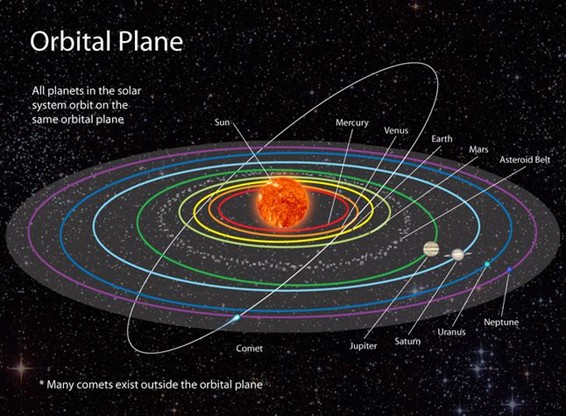
The Solar System looks like a huge flat disk (reference Image X). All eight planets orbit the Sun in the plane of this disk. The orbits are not perfectly on the same plane but they are close enough for our purposes.
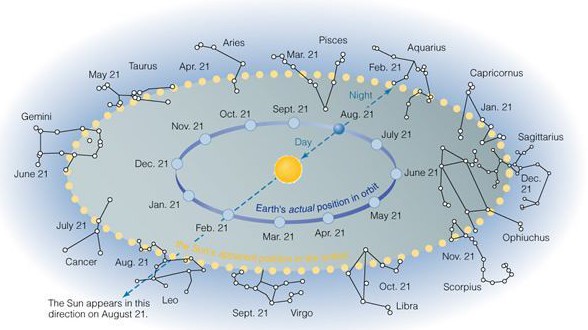
Now, pretend you’re looking up at the Sun from Earth’s surface. Depending on the date, the Sun will have a different backdrop of stars. Take a look at Image XX. Note the position of the Earth (the small blue disk) in relation to the Sun on August 21. During the daytime, if you could see the stars behind the Sun, you would see the constellation Leo. As time passes and the Earth progresses around the Sun, the background of stars behind the Sun will continue to change, progressing around the constellations of the zodiac. On September 21, you would see the constellation Virgo. On October 21, you would see the constellation Libra, and so on.
Due to the Earth’s rotation around the Sun, the Sun appears to make a path to a different area of the sky. After the passage of a year, the Sun completes the circle and is almost back where it started. The circle, or path, the Sun makes in the sky is called the ecliptic.
Because the planets orbit the Sun in almost the same plane as the Earth, they will also follow the ecliptic. It’s not exact but it’s useful for getting an idea of where they should be.
Don’t confuse the motion of the Sun along the ecliptic (caused by the Earth’s rotation around the Sun) with the Earth’s rotation on it’s axis, which causes night and day. It’s not the same path.
The orbits of Venus and Mercury are closer to the Sun than Earth’s orbit. For that reason, they will always be near the Sun, very close to the ecliptic and near the sunrise and sunset.
The planets with orbits outside Earth’s orbit, including Saturn and Jupiter, will move across the whole ecliptic.
The easiest way to find the ecliptic is to install a star map app on your phone. Most of these maps will show the ecliptic and as long as you can see the ecliptic, you can find the planets.
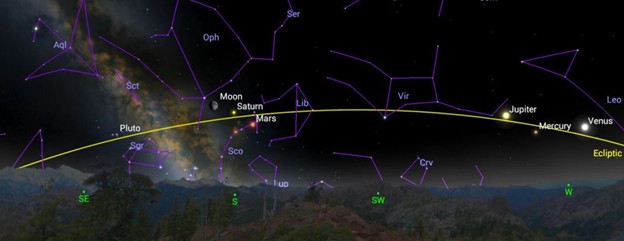
Another way is to keep track of the Sun and the Moon. The Sun will always be on the ecliptic. The Moon’s orbit tilts approximately 5 degrees off the ecliptic so it will always be within 5 degrees of it. That’s about the width of three fingers held together at the end of your outstretched arm.
Alpha Centauri Star SystemAuthor: Sherry Ramanathan
The Alpha Centauri Star System is the closest star system to our Sun. It contains three stars. The dimmest star, which also happens to be the star closest to earth other than our own Sun, is Proxima Centauri (also known as Alpha Centauri C) at 4.25 light years away. The other two stars, Alpha Centauri A and B, form a “close binary system”. A binary star system simply means the system consists of two stars that revolve around each other. The Alpha Centauri binary system is considered ‘close’ because the two stars are currently separated by only 23 Astronomical Units. An Astronomical Unit (AU) is the average distance between the Earth and the Sun or about 93 million miles (150 million kilometers). One AU times 23 is a little bit greater than the distance between Uranus and the Sun.
While A and B revolve around each other, Proxima Centauri revolves around both A and B, making Alpha Centauri a triple star system.
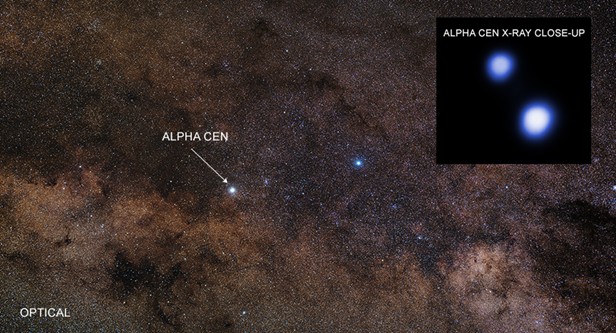
Why It’s Important: It’s a triple star system containing the closest star to our Sun and has one known exoplanet.
Alpha Centauri is interesting for many reasons but for our purposes, two things stand out. Alpha Centauri A is the same type of star as our Sun and Proxima Centauri has a potentially habitable exoplanet. In other words, the star closest to the Sun has a planet that is similar to Earth. The planet sits in an orbital zone that could allow liquid water to exist, a key ingredient for life on Earth.
Proxima Centauri is a red dwarf star, which is cooler and redder than our Sun and the planet, Proxima b, orbits extremely close to it. One year on Proxima b is only 11 days on Earth. Although Proxima b orbits within the habitable zone of Proxima Centauri, it is not known whether it has an atmosphere, which would impact habitability. Proxima Centauri is a flare star with intense emission of electromagnetic radiation that could strip an atmosphere off the planet.
At this point, it is unknown whether life exists on Proxima b. Lifeforms on this planet would have to withstand the cooler conditions and electromagnetic radiation of the red dwarf star. However, if life does exist, at 4.25 light years away, it’s considered close enough for 2-way communication.