Buried within a recently published Department of War UFO file is the forgotten story of two Oklahoma teenagers who helped build one of America’s earliest civilian UFO research organizations, decades before the internet transformed how information traveled across the country.
The file, titled “65_HS1-834228961_62-HQ-83894_Section_9,” contains federal correspondence referencing Hayden C. Hewes, James Maney, and the Interplanetary Intelligence of Unidentified Flying Objects (IIOUFO), a research organization founded in Oklahoma City in 1957. Over time, the IIOUFO would evolve into what is known today as the International UFO Bureau (IUFOB).
The records provide an independently documented glimpse into the organization’s early years and the growing visibility it achieved during the formative era of UFO research in America.
Long before congressional hearings, viral military footage, or social media debates, teenage researchers in Oklahoma were already organizing nationwide reporting networks dedicated to investigating unexplained aerial sightings. Hayden Hewes founded the IIOUFO while still in his teens, and James Maney joined him as deputy director at only fourteen years old.
By combining surviving newspaper coverage from the period with preserved organizational archives and recently released federal records, a documented timeline is established for the organization’s early growth. At a time when most Americans were only beginning to hear the phrase “flying saucer,” the Oklahoma-based group was already publishing research materials, organizing skywatch efforts, and corresponding with witnesses and researchers across the country.
What makes the story especially remarkable is the era in which it unfolded. The young founders were building research and communication networks years before email, digital databases, or online communities existed.
Witness reports arrived through mailed letters and telephone calls. Photographs, newsletters, typed documents, and volunteer observer posts became the backbone of early investigative efforts. Surviving records show that the IIOUFO was already developing structured reporting systems during a period when nearly all civilian UFO research relied entirely on grassroots organization and public participation.
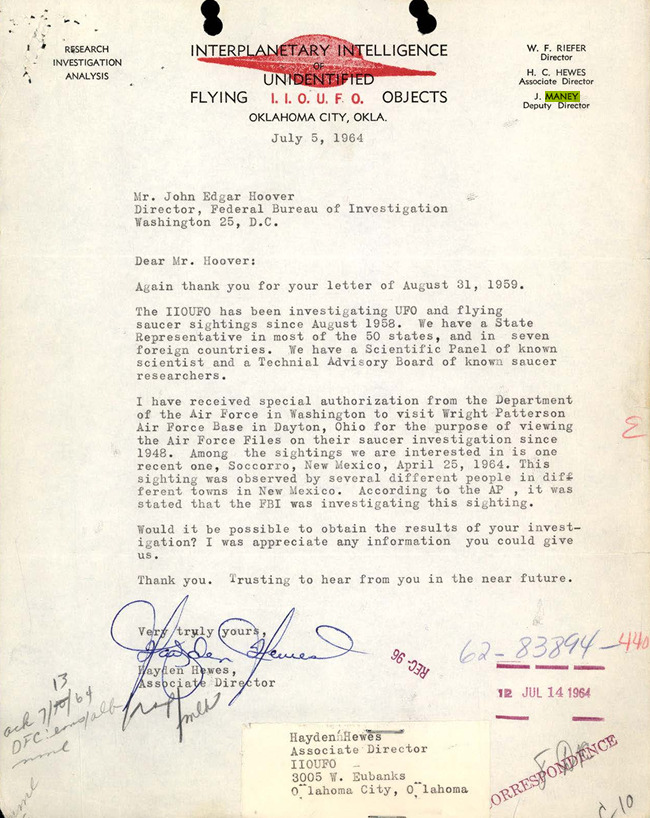
Among the most historically significant documents in the file is a July 5, 1964 letter written by Hayden Hewes to FBI Director J. Edgar Hoover. In the correspondence, Hewes states that he had received authorization from the Department of the Air Force to visit Wright-Patterson Air Force Base in Dayton, Ohio. The purpose for the visit was for Hayden to personally review Air Force files related to unidentified flying object investigations dating back to 1948.
Additional archival material preserved within the IUFOB collection includes a June 22, 1964 response from the Department of the Air Force confirming that Project Office personnel at Wright-Patterson would welcome Hewes’ visit and arrange access to files concerning unidentified flying objects. Records and video preserved within the IUFOB archive further indicate that Hewes did in fact make the visit.
What followed afterward would further elevate the organization’s prominence. Correspondence preserved within the IUFOB archive shows that Hayden Hewes’ visit to Wright-Patterson Air Force Base led to continued communication with figures directly involved in the United States government’s early UFO research efforts during the 1960s.
Among the surviving materials is correspondence from Major Hector Quintanilla, the U.S. Air Force officer who served as head of Project Blue Book, the government’s official UFO investigation program during one of the most active periods in modern UFO history. In the letter, Quintanilla references ongoing discussion regarding unidentified flying objects and offers assistance to the IIOUFO following Hewes’ Wright-Patterson visit.
The correspondence reflects the degree of visibility and credibility the young organization had achieved during its formative years.
Historically, the IIOUFO occupies a unique place within the post-1947 flying saucer era in America. The organization was among the earliest known civilian UFO research groups established in the United States during the first major wave of public interest surrounding unidentified aerial phenomena.
Federal correspondence contained within the Department of War files identifies Hewes as Associate Director of the IIOUFO and references communication involving UFO-related reports and publications. Additional documents identify James Maney in connection with UFO research activity while still only a teenager in Oklahoma City. Together, the records help document the organization’s early development and growing visibility during the late 1950s and early 1960s.
Unlike many early UFO organizations that eventually disappeared, the original research effort founded in Oklahoma City continued evolving over the decades. The IIOUFO later became known as the International UFO Bureau while maintaining continuity from its original 1957 founding.
Preserved archives, historical correspondence, newspaper coverage, and federal records now help document that organizational lineage across nearly seventy years of operation. The survival of those materials provides an unusually detailed historical window into the early civilian UFO movement in America.
For current IUFOB leadership, the significance of the records is rooted less in sensationalism and more in preservation, continuity, and overlooked American history.
“These records help document a real and often forgotten part of Oklahoma history,” said IUFOB CEO Mindy Tautfest. “The files show that organized civilian UFO research was already taking shape here in Oklahoma during the 1950s. The material preserved within our archive continues to provide important historical context for how these early organizations operated, communicated, and evolved over time.”
Now approaching seventy years since its founding, the International UFO Bureau continues operating from Oklahoma while preserving historical UFO archives and developing modern investigative and reporting systems focused on unidentified aerial phenomena. What began as a small research effort organized by Oklahoma teenagers in 1957 has grown into one of the longest-running UFO research organizations in the United States.
Intelligence Brief: Pentagon UAP Briefings Added in NDAA – MeriTalkThe recent report from MeriTalk, a leading government IT and contracting news source, has sparked widespread interest in the UFO community. The headline “Pentagon UAP Briefings Added in NDAA” indicates that the United States Department of Defense (DoD) will now include Unidentified Aerial Phenomena (UAP) briefings as part of their annual National Defense Authorization Act (NDAA).
This development marks a significant milestone in the government’s acknowledgment and investigation of UAP sightings. As the lead intelligence analyst for the International UFO Bureau (IUFOB), it is essential to provide a comprehensive analysis of this event.
Core Details & Observations
According to the report, the inclusion of UAP briefings in the NDAA will enable the DoD to better coordinate and share information about UAP sightings across various military branches. This move aims to improve the overall understanding of these phenomena and potentially identify patterns or connections that may have implications for national security.
The addition of UAP briefings is seen as a significant step forward, considering the previous reluctance of government agencies to acknowledge or investigate such sightings. The inclusion of this topic in the NDAA underscores the growing recognition of the importance of UAP research in the context of national defense and security.
It’s worth noting that the term “UAP” is often used interchangeably with “Unidentified Flying Object” (UFO), but the former term emphasizes the focus on the aerial phenomena rather than the object itself. This subtle distinction highlights the shift towards a more scientific approach, focusing on the observed events rather than speculative interpretations.
Scientific & Anomalous Significance
The inclusion of UAP briefings in the NDAA has significant implications for advanced physics and UAP research. By acknowledging the existence of these phenomena and encouraging further investigation, the government is implicitly recognizing the possibility that some UAP sightings may be related to emerging technologies or even extraterrestrial life.
From a scientific perspective, this development opens up new avenues for interdisciplinary research, combining expertise from fields such as astrophysics, aerodynamics, materials science, and computer simulations. The study of UAP can provide valuable insights into the nature of reality, the behavior of matter and energy, and potentially even the existence of other forms of life.
Furthermore, the incorporation of UAP briefings in the NDAA may lead to a more comprehensive understanding of the phenomena, which could have far-reaching implications for fields such as astrobiology, exoplanetary science, and SETI (Search for Extraterrestrial Intelligence).
The recognition of UAP as a legitimate area of study can also foster international cooperation and collaboration, as scientists from various countries begin to share data and theories.
In conclusion, the addition of UAP briefings in the NDAA is a significant development that marks a turning point in the government’s approach towards UAP research. As the analyst for the IUFOB, it is essential to continue monitoring this situation closely and providing in-depth analyses of any new findings or developments.
The implications of this event are far-reaching, and we can expect a flurry of scientific papers, conferences, and debate as researchers and experts delve deeper into the mysteries of UAP.
Source intelligence:
Original Report