If you’ve spent any time at all investigating UFO sightings, one thing will eventually become very clear: Planets often are mistaken for UFOs. Venus, Jupiter, and Saturn are typically the guilty parties because they are bright, sometimes very bright. When a witness reports a bright light in the sky, even if they report it moving (see FI Training Minute in this issue), planet positions are one of the first things to check.
There are several excellent software packages that can help determine if that bright light is a planet. However, sometimes finding a planet, even within the software, can be difficult. Also, there may be times when you’ll want to have an idea of whether or not a sighting might be a planet when you don’t have immediate access to software. One way to do that is to understand how planetary orbits work and how that appears to someone standing on planet earth.
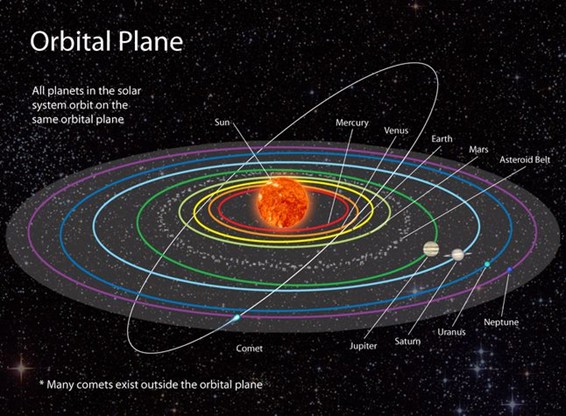
The Solar System looks like a huge flat disk (reference Image X). All eight planets orbit the Sun in the plane of this disk. The orbits are not perfectly on the same plane but they are close enough for our purposes.
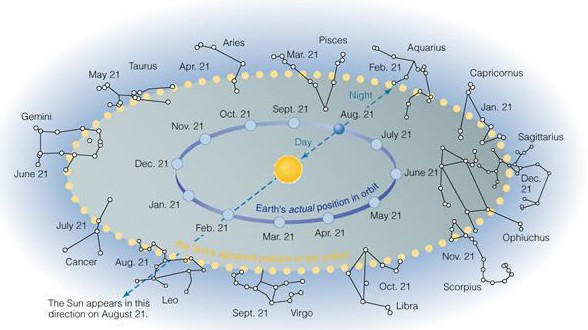
Now, pretend you’re looking up at the Sun from Earth’s surface. Depending on the date, the Sun will have a different backdrop of stars. Take a look at Image XX. Note the position of the Earth (the small blue disk) in relation to the Sun on August 21. During the daytime, if you could see the stars behind the Sun, you would see the constellation Leo. As time passes and the Earth progresses around the Sun, the background of stars behind the Sun will continue to change, progressing around the constellations of the zodiac. On September 21, you would see the constellation Virgo. On October 21, you would see the constellation Libra, and so on.
Due to the Earth’s rotation around the Sun, the Sun appears to make a path to a different area of the sky. After the passage of a year, the Sun completes the circle and is almost back where it started. The circle, or path, the Sun makes in the sky is called the ecliptic.
Because the planets orbit the Sun in almost the same plane as the Earth, they will also follow the ecliptic. It’s not exact but it’s useful for getting an idea of where they should be.
Don’t confuse the motion of the Sun along the ecliptic (caused by the Earth’s rotation around the Sun) with the Earth’s rotation on it’s axis, which causes night and day. It’s not the same path.
Finding the Planets
The orbits of Venus and Mercury are closer to the Sun than Earth’s orbit. For that reason, they will always be near the Sun, very close to the ecliptic and near the sunrise and sunset.
The planets with orbits outside Earth’s orbit, including Saturn and Jupiter, will move across the whole ecliptic.
The easiest way to find the ecliptic is to install a star map app on your phone. Most of these maps will show the ecliptic and as long as you can see the ecliptic, you can find the planets.
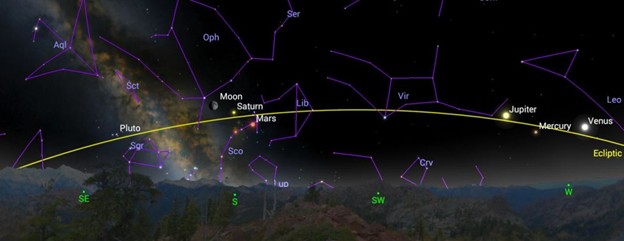
Another way is to keep track of the Sun and the Moon. The Sun will always be on the ecliptic. The Moon’s orbit tilts approximately 5 degrees off the ecliptic so it will always be within 5 degrees of it. That’s about the width of three fingers held together at the end of your outstretched arm.