Alpha Centauri Star System
Author: Sherry Ramanathan
The Alpha Centauri Star System is the closest star system to our Sun. It contains three stars. The dimmest star, which also happens to be the star closest to earth other than our own Sun, is Proxima Centauri (also known as Alpha Centauri C) at 4.25 light years away. The other two stars, Alpha Centauri A and B, form a “close binary system”. A binary star system simply means the system consists of two stars that revolve around each other. The Alpha Centauri binary system is considered ‘close’ because the two stars are currently separated by only 23 Astronomical Units. An Astronomical Unit (AU) is the average distance between the Earth and the Sun or about 93 million miles (150 million kilometers). One AU times 23 is a little bit greater than the distance between Uranus and the Sun.
While A and B revolve around each other, Proxima Centauri revolves around both A and B, making Alpha Centauri a triple star system.
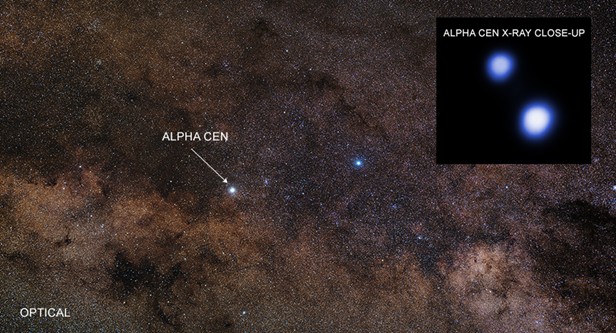
Why It’s Important: It’s a triple star system containing the closest star to our Sun and has one known exoplanet.
Alpha Centauri is interesting for many reasons but for our purposes, two things stand out. Alpha Centauri A is the same type of star as our Sun and Proxima Centauri has a potentially habitable exoplanet. In other words, the star closest to the Sun has a planet that is similar to Earth. The planet sits in an orbital zone that could allow liquid water to exist, a key ingredient for life on Earth.
Proxima Centauri is a red dwarf star, which is cooler and redder than our Sun and the planet, Proxima b, orbits extremely close to it. One year on Proxima b is only 11 days on Earth. Although Proxima b orbits within the habitable zone of Proxima Centauri, it is not known whether it has an atmosphere, which would impact habitability. Proxima Centauri is a flare star with intense emission of electromagnetic radiation that could strip an atmosphere off the planet.
At this point, it is unknown whether life exists on Proxima b. Lifeforms on this planet would have to withstand the cooler conditions and electromagnetic radiation of the red dwarf star. However, if life does exist, at 4.25 light years away, it’s considered close enough for 2-way communication.